
Ask ten superyacht engineers what "planned maintenance" means and you'll get answers ranging from "a folder of PDFs the manufacturer sent" to "an ISM requirement we have to satisfy" to "the spreadsheet I inherited from the last chief." All of these are partially right. None of them are the whole picture.
Planned maintenance, done properly, is the system that keeps a superyacht safe, operational, and compliant — the discipline that prevents the failures that ruin charter weeks and end careers. This article walks through what it actually involves, what separates a working PMS from a paper exercise, and why every commercially operated yacht needs one.
What "planned maintenance" actually means
A Planned Maintenance System, or PMS, is a structured approach to keeping every piece of equipment on a vessel in working order through scheduled, documented intervention — rather than waiting for things to break.
The core idea is simple: every system onboard, from the main engines to the watermakers to the gyro stabilizers, has a manufacturer-recommended service interval. Run hours, calendar months, fuel burned, cycles completed — different machines have different metrics. A PMS captures those intervals, generates work orders when they come due, records what was done, and keeps a permanent history of every intervention.
Done well, this answers four questions for any piece of equipment onboard:
- When was it last serviced?
- When is it next due?
- What was actually done during the last service?
- Who did it?
A surprising number of yachts can't answer those questions reliably for their critical equipment. That's the gap a real PMS closes.
Why ISM-coded yachts have no choice
For yachts operating under the International Safety Management (ISM) Code — which includes essentially all commercial charter vessels and many large private yachts — planned maintenance isn't optional. The Code requires that vessels "establish procedures to ensure that the ship is maintained in conformity with the provisions of the relevant rules and regulations" and that records of maintenance activities are kept and available for inspection.
In practice, what auditors want to see is straightforward but specific:
- A complete equipment register covering all critical systems
- Defined maintenance procedures for each piece of equipment
- Evidence that those procedures are being followed at the required intervals
- Records of completed work, including who performed it and when
- Documentation of any deficiencies and the actions taken to address them
A binder of manufacturer manuals and a half-maintained spreadsheet won't pass scrutiny. Neither will a system where the data exists but nobody can produce it on demand during an audit.
The components of a working PMS
A real planned maintenance system has several components working together. Each one supports the others.
Equipment register
Everything starts with knowing what's onboard. A complete equipment register documents every piece of equipment — make, model, serial number, location, install date, warranty status, and the manufacturer's recommended service intervals. Without this foundation, nothing else works.
The register should also link related items together: the spares for a specific watermaker, the manuals for a specific generator, the historical service records for a specific stabilizer. When the chief engineer is troubleshooting at 0200, they shouldn't be searching three separate systems to find what they need.
Scheduling engine
Once equipment and intervals are defined, the system should generate maintenance tasks automatically. A monthly oil sample on the main engines, a 250-hour service on the generator, an annual inspection of the life raft hydrostatic releases — all of these should appear as work orders without anyone having to remember to create them.
Good scheduling engines handle multiple interval types simultaneously: calendar-based (every 90 days), usage-based (every 500 run hours), and condition-based (when fuel filter pressure drops to a threshold).
Task and work order management
When a maintenance task comes due, the system should make it easy for whoever's performing the work to do it correctly. That means linking the work order to the relevant manufacturer procedure, listing the spares required, identifying the tools needed, and providing space to record what was actually done.
This is where many PMS implementations fall apart. If logging a completed task takes ten minutes of clicking through screens, crews stop doing it. The friction has to be low enough that documentation becomes routine rather than an end-of-shift burden.
Maintenance history
Every completed task should be permanently recorded — what was done, by whom, on what date, with what parts. Over time this maintenance history becomes one of the most valuable assets onboard. It informs warranty claims, supports troubleshooting when problems recur, and provides the audit trail that ISM compliance requires.
It also survives crew changes. When a new chief engineer steps aboard and asks "when was the last time we changed the cooling water on the port main?", the answer should be in the system, not in someone's memory.
Inventory and spares linkage
Maintenance tasks consume parts. A PMS that doesn't connect to inventory creates a different problem: technicians know what needs to be done but can't tell whether the spares are actually onboard. The result is mid-job discoveries that the required filter or O-ring isn't in the locker, and a delay while parts are shipped from a chandler in Antibes.
Linking equipment to its specific spares, and tracking those spares against minimum stock levels, closes that gap.
Certification tracking
Beyond equipment maintenance, yachts have a parallel set of obligations: certificates that expire, surveys that come due, crew qualifications that need renewal. Treating these as part of the maintenance system through proper certification tracking — with the same automated reminders and audit trail — keeps them from becoming the surprise that delays a charter.
What separates working systems from paper exercises
Plenty of yachts have something they call a planned maintenance system. Far fewer have one that's actually working. The difference comes down to a few characteristics.
The data is current. A PMS that nobody has updated in three months isn't a PMS. It's an artifact. Working systems are touched daily by the people doing the work, not maintained as a quarterly project by whoever has time.
The tasks generate themselves. If creating a work order requires a human to remember the interval, the system will eventually fail. Crew turnover, busy seasons, and simple human attention spans guarantee it. Real PMS implementations push tasks at the crew automatically.
It survives crew changes. A system that only the previous chief engineer understood is a liability. The next person stepping into that role should be able to look at the screen and immediately understand what's overdue, what's coming up, and what's been done.
Reports are runnable on demand. When the management company asks for an overdue maintenance report or the Flag State auditor asks to see records for a specific piece of equipment, the answer should take minutes, not days.
The crew uses it because it helps, not because they're told to. This is the strongest signal. If the system saves crew time — by surfacing the right manual at the right moment, by eliminating duplicate data entry, by making handovers easier — it gets used. If it adds friction, it gets bypassed.
What this looks like in practice
A well-running PMS on a 60-meter motor yacht might involve:
- An equipment register of several hundred items, each linked to manuals, spares, and historical records
- A few dozen automatically generated maintenance tasks per week, ranging from quick five-minute checks to scheduled full services
- Real-time visibility for the captain into what's overdue, what's coming up in the next 30 days, and what's been completed
- Documentation that satisfies the next ISM audit without requiring a week of preparation
- A permanent operational history that adds value to the vessel at sale and supports warranty claims throughout ownership
None of this is theoretical. It's how vessels with disciplined maintenance programs operate every day. The yachts that don't operate this way tend to discover the consequences during the moments they can least afford them — equipment failures during charter, deficiencies during audits, surprise costs during refits.
Where to start if you're not there yet
If your yacht is running on spreadsheets, paper logs, or a half-implemented system that nobody really uses, the path forward is more achievable than it might seem. Start with the critical equipment — main engines, generators, life safety, navigation — and build out from there. Get the equipment register right first. Define the intervals. Let the system generate the work. Document what's done.
The investment in setting up a real PMS pays back quickly: in reduced unplanned downtime, in cleaner audits, in handovers that don't lose institutional knowledge, and in the simple confidence that comes from knowing the boat is being looked after properly.
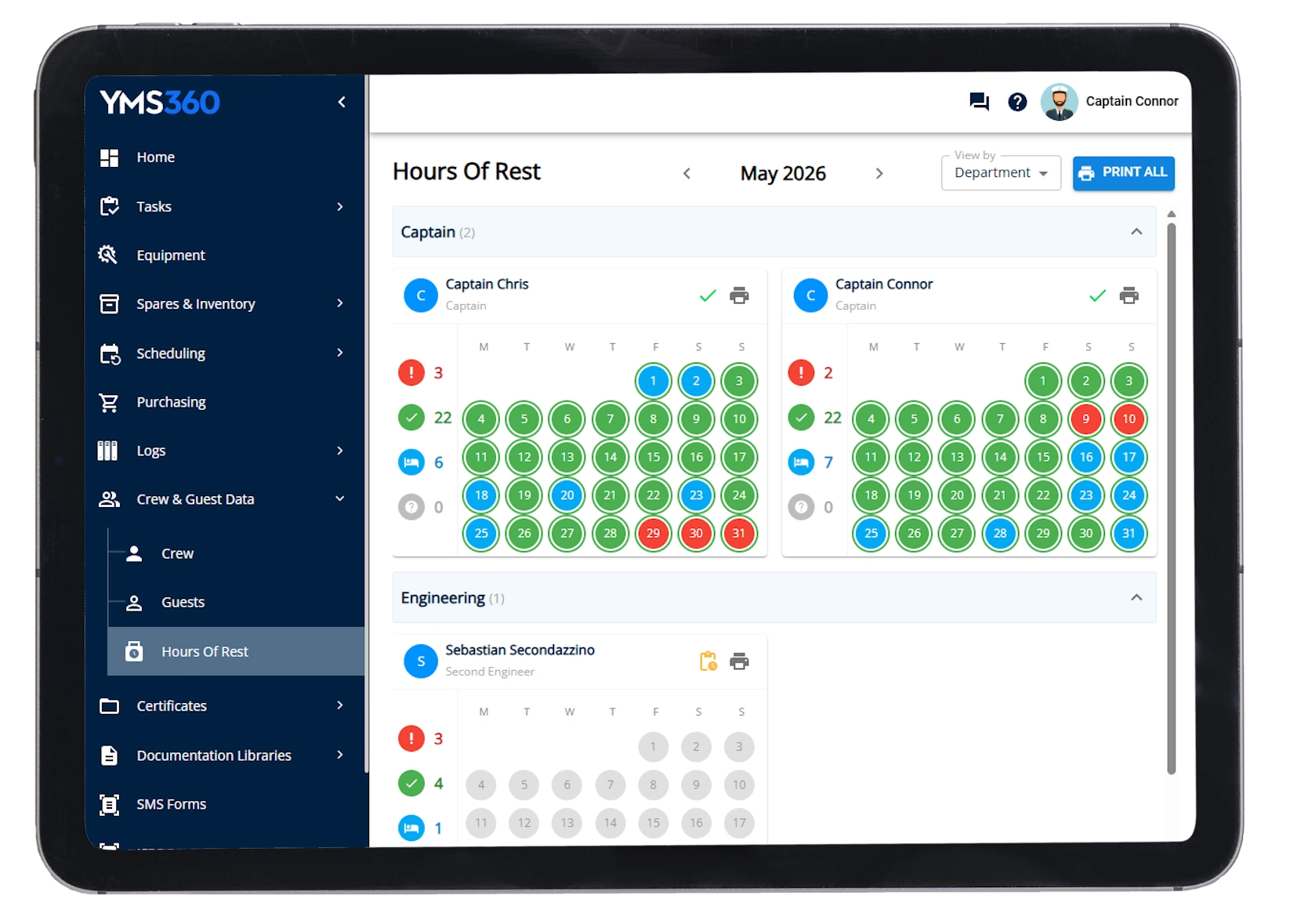
YMS360 was built specifically for this — purpose-built planned maintenance for superyachts, with twenty-five years of industry experience behind every design decision. If you'd like to see what a working PMS looks like for your vessel, we'd be glad to show you.