
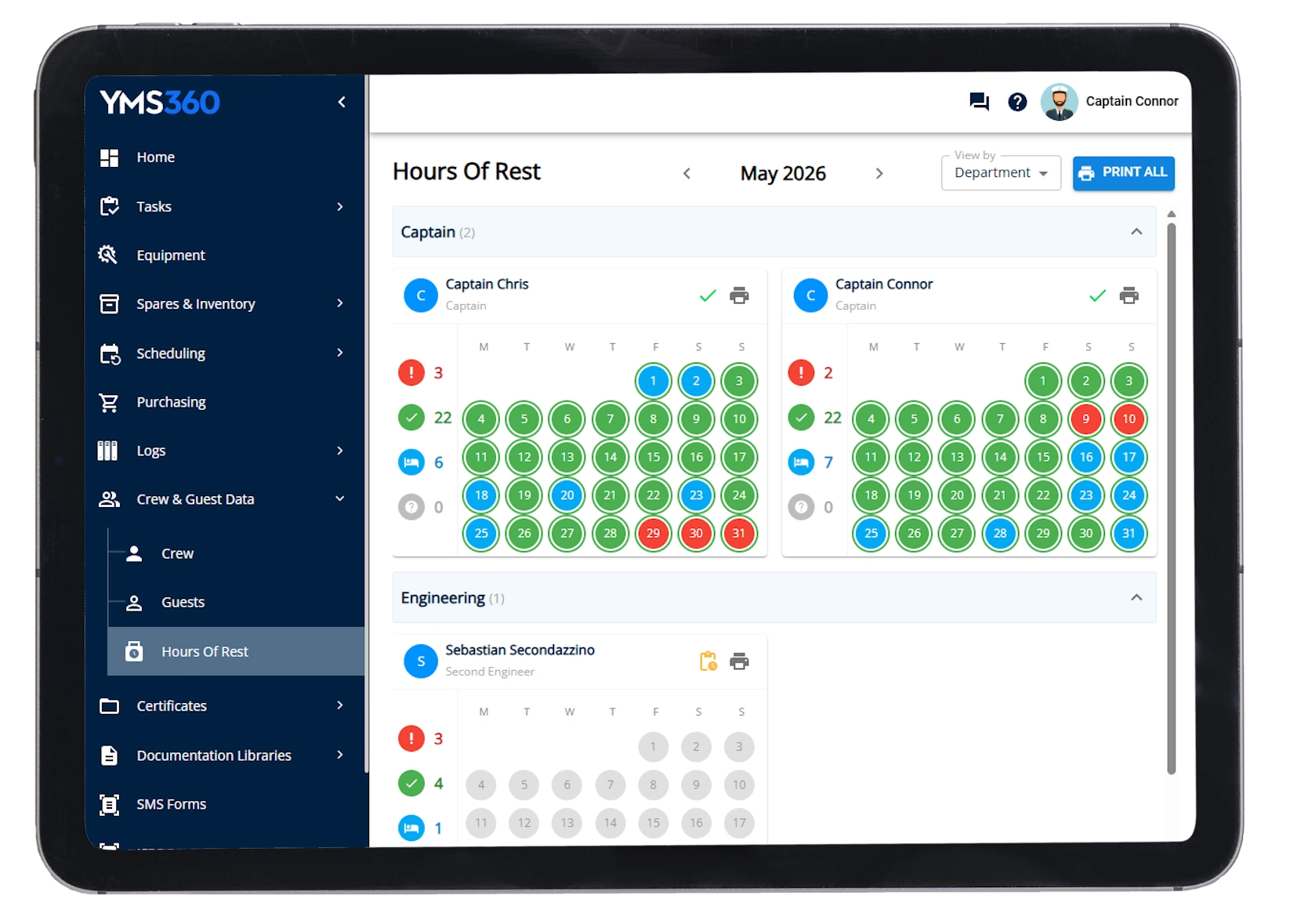
On paper, hours of rest look like two numbers: ten hours in a day, seventy-seven in a week. Most crew can recite them. Yet rest-hour deficiencies remain one of the most common findings raised in port state control inspections — not because the headline figures are hard to remember, but because the detail underneath them is where compliance is actually won or lost.
This is a working review of the rules governing seafarer rest: the two instruments that set them, how they differ, the structure-of-rest provisions that catch people out, the exceptions and how far they stretch, what has to be recorded, and how it all gets tested in an inspection. Every regulatory point links to the primary source so it can be checked directly rather than taken on trust.
Two instruments, not one
Seafarer rest is governed by two separate international instruments that were deliberately harmonised but are not identical.
The first is the STCW Convention and Code, specifically Section A-VIII/1 (Fitness for duty), which sits within the watchkeeping standards. This is the IMO instrument, and its rest provisions were substantially tightened by the 2010 Manila amendments. (IMO STCW Convention overview · full text of STCW Chapter VIII, Section A-VIII/1)
The second is the Maritime Labour Convention, 2006 (MLC, 2006), the ILO instrument, specifically Regulation 2.3 and Standard A2.3 (Hours of work and hours of rest). (ILO MLC, 2006 — official page · MLC, 2006 as amended — authentic text)
The two were aligned in 2010 so that the rest-hour minimums match. They are not, however, the same instrument with the same scope or the same enforcement route — and one important number does not line up between them, which we come to below. A vessel is generally subject to both.
The core limits — and the choice the flag state makes
MLC Standard A2.3 requires each flag administration to fix either a maximum number of hours of work or a minimum number of hours of rest. The two regimes are:
- Maximum hours of work: no more than 14 hours in any 24-hour period, and 72 hours in any seven-day period; or
- Minimum hours of rest: no less than 10 hours in any 24-hour period, and 77 hours in any seven-day period.
STCW A-VIII/1 expresses only the minimum-rest version: 10 hours in any 24, 77 hours in any seven days.
The choice between the two regimes is the flag state's, and it matters more than it first appears. The daily figures are equivalent (14 hours of work is 10 hours of rest). The weekly figures are not. Under the maximum-work regime, the ceiling is 72 hours of work per week. Under the minimum-rest regime, 77 hours of rest in a 168-hour week leaves up to 91 hours in which a seafarer could, in principle, be worked. The same crew member can therefore face a materially different effective ceiling depending only on which standard their flag adopted. This divergence between the 72-hour and 77-hour standards is well documented and is one reason fleets standardise their record-keeping carefully. (academic review of the work/rest standards, European Labour Law Journal, 2026)
In practice many operators record hours of rest only, because tracking against the rest minimums keeps a single consistent measure and avoids the liability that comes with maintaining parallel work-hour figures that can be challenged.
The structure-of-rest rules — where most deficiencies live
Hitting the daily and weekly totals is not enough. Both instruments constrain how the rest is arranged:
- Rest may be divided into no more than two periods in a 24-hour window.
- One of those periods must be at least six hours in length.
- The interval between two consecutive periods of rest must not exceed 14 hours.
These three lines generate more findings than the headline totals, and the reason is the phrase "in any 24-hour period." It does not mean the calendar day from midnight to midnight. It means any rolling 24-hour window. A schedule that looks compliant when read as fixed days can breach the rule the moment an inspector slides the 24-hour window to start at, say, 05:00. A six-hours-on / six-hours-off rotation illustrates the trap neatly: it delivers twelve hours of rest across the day, but never a single unbroken six-hour block, so it fails the structure test even though the total looks generous.
This rolling-window calculation is the single most common source of confusion, and it is the reason rest hours cannot reliably be assessed by eye at the end of a week. (worked examples of the "any 24-hour period" calculation)
Exceptions, exemptions and overriding conditions
The rules bend in defined ways — and knowing exactly how far they bend is part of staying compliant rather than improvising.
Emergencies and overriding operational conditions. Under STCW A-VIII/1, the rest-period requirements need not be maintained in an emergency or other overriding operational condition. The master retains an explicit right to require any hours of work necessary for the immediate safety of the ship, persons on board or cargo, or to assist others in distress. Once the normal situation is restored, the master must ensure affected seafarers receive an adequate period of rest. The equivalent appears in MLC Standard A2.3. The point to watch is that several administrations do not treat routine activities — arrival and departure, cargo operations — as "overriding operational conditions," so leaning on this provision for ordinary port work is a frequent misstep.
Permitted exceptions to the limits (STCW A-VIII/1, para 9). A flag state may allow exceptions, within tight bounds:
- Weekly rest may be reduced to a minimum of 70 hours, but not for more than two consecutive weeks, and the interval between two periods of exceptions must be at least twice the duration of the exception.
- Rest may be split into no more than three periods (one at least six hours, the other two at least one hour each), with the 14-hour interval still applying, and such exceptions not extending beyond two 24-hour periods in any seven-day period.
Collective agreements (MLC Standard A2.3). National laws or registered collective agreements may permit exceptions to the limits. These should, as far as possible, still follow the convention's provisions and may account for compensatory leave for watchkeepers or short-voyage crews.
On-call work. Where a seafarer is on call — for example, an unattended machinery space — they must receive an adequate compensatory rest period if their normal rest is disturbed by call-outs.
Drills
Musters, fire-fighting and lifeboat drills, and drills required by national law or international instruments must be conducted so as to minimise the disturbance of rest periods and not induce fatigue. This is a genuine requirement, not a courtesy. In practice, drills scheduled late in the week are a recurring source of rest-hour findings, which is why experienced masters log the planned split of rest periods in advance of a scheduled drill rather than reconstruct it afterwards.
Who the rules cover
STCW A-VIII/1 applies to anyone assigned as officer in charge of a watch or as a rating forming part of a watch, and to those whose duties involve designated safety, prevention of pollution or security responsibilities. The 2010 amendments widened this so that it is no longer only the bridge and engine-room watch that are captured.
Seafarers under 18 are subject to stricter limits, including longer minimum rest and restrictions on night work, set out in the MLC's minimum-age provisions (MLC, 2006 — text and structure). Any vessel carrying crew under 18 should treat the standard adult limits as a floor, not the applicable rule.
What has to be recorded
Records are not an administrative afterthought; they are the substance of compliance, because they are the only thing an inspector can examine.
- Records of each seafarer's daily hours of work or hours of rest must be maintained.
- They must follow a standardised format established by the competent authority, taking account of the IMO/ILO Guidelines for the development of tables of shipboard working arrangements and the formats of records of hours of work or rest.
- The table of working arrangements must be posted where it is easily accessible, in the working language(s) of the ship and in English.
- The seafarer must receive a copy of their own records, endorsed by the master (or an authorised person) and by the seafarer.
- Records must be kept on board and retained for inspection; the retention period is set by the flag administration. Even where an electronic system is used, a legible version must be available for inspection.
A flag-state model of the standardised record format gives a sense of what this looks like in practice (Luxembourg model formats — table of shipboard working arrangements and record of hours of rest).
How it is enforced
Rest hours are inspectable, and the inspection is rarely a simple read of the record on its own. Port state control officers, flag inspectors and labour inspectors cross-reference the rest record against other onboard evidence — deck and engine logs, the watch schedule, port-call timings, drill registers, and position or voyage data. A record that is internally tidy but inconsistent with the vessel's actual movements is the classic trigger for a closer look.
Two consequences are worth keeping in view. First, falsification of rest records is treated as a serious breach — of the MLC, and potentially of the vessel's certification — not as a paperwork slip. Second, where the vessel's manning or work organisation makes compliance genuinely impossible, the failure is regarded as a systemic management issue rather than an individual breach by the crew member. Persistent or structural rest-hour violations can lead to deficiencies, detention, or action against certification. (US Coast Guard policy guidance on STCW hours of rest — a clear summary of the 2010 changes and enforcement expectations)
The superyacht reality
The instruments are written for merchant shipping, but they apply to commercially registered yachts, and the operating pattern of a large yacht is where the rules bite hardest. Charter seasons compress months of intense activity into a short window. Guest trips run to no fixed schedule. Port days stack arrivals, departures, provisioning, tenders and guest movements on top of a normal working day. Reduced manning on smaller watch teams leaves little slack when any of this overruns.
The result is that the structure-of-rest rules — the six-hour block, the 14-hour interval, the rolling 24-hour window — are tested constantly, often on the busiest days, precisely when the record is most likely to be reconstructed later from memory. That reconstruction is the weak point. It is also exactly what an inspector's cross-check is designed to find.
Making the records hold up
None of this calls for heroics. It calls for the rest record to be captured in the flow of operations, against the same operational record as everything else the vessel logs, rather than assembled at the end of the week. When rest is recorded as it happens, the rolling-window calculation can be run continuously rather than discovered in arrears, the structure rules can be checked before a breach is locked in, and the record reconciles with the logs because it was built alongside them.
That is the operational difference between a record that survives a cross-check and one that invites a second read.
YMS360's crew module keeps hours of work and rest against the same record as the rest of the vessel's operations, so rest hours stay calculated and inspection-ready rather than reconstructed after the fact. If that's useful for your fleet, see how it works at yms360.com.
Primary and official sources
- STCW Convention & Code — Section A-VIII/1 (Fitness for duty): full text, Chapter VIII · IMO STCW overview
- MLC, 2006 — Regulation 2.3 / Standard A2.3 (Hours of work and hours of rest): ILO official page · authentic text, as amended
- IMO/ILO standardised record format — flag-state model (Luxembourg): table of working arrangements and record of hours of rest
- US Coast Guard policy guidance on STCW hours of rest: policy letter
This article is a general guide and not legal or compliance advice. Flag-state implementation varies; always confirm the requirements that apply to your vessel against its flag administration's regulations and the primary instruments linked above.